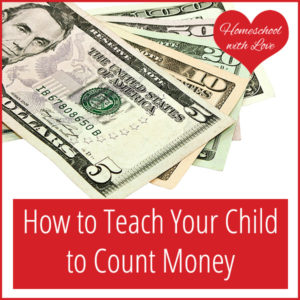
It’s important for your child to learn to count money.
Even in this age of debit cards and online banking, money is still used for shopping.
Also, if your child ever works in a store, the ability to count money is an essential skill.
Let me share with you some tips and activities for teaching your child money skills.
Teach Your Child to Count Money
Skip Counting First
Before going to the bank to get rolls of coins, it is best to start by teaching your child to skip count on a daily basis. This is a good skill to practice in both kindergarten and first grade. It makes a great warm up for math.
I would have your child practice skip counting 5’s, 10’s, and 25’s to 100. I also encouraged skip counting odd and even numbers to 20 in another article I wrote about teaching addition facts. So you might want to include those in your routine.
You can have the numbers written out for practice or use a hundreds chart. This is good for visual learners. If your child is kinesthetic, you can have him bounce a ball or clap for each number he skip counts. Auditory learners learn it by hearing it. For all learners, you can also use the chants I have below to make it a little more fun.
Money Chants
Here are some chants I wrote for learning to count nickels, dimes, and quarters. They can be used as skip roping chants if you want.
Pirate Pickle by Susan Brown
Pirate Pickle took some nickels,
From a girl who’s very fickle.
She got mad and let out a squeal.
How much money did he steal?
5, 10, 15, 20,
25, 30, 35, 40,
45, 50, 55, 60,
65, 70, 75, 80,
85, 90, 95, 100
That is what the pirate plundered.
Stormy Skies by Susan Brown
I was counting dimes one day
When a storm came by my way.
While I ran to the town of Pike
How many times did lightning strike?
10, 20,
30, 40,
50, 60,
70, 80,
90, 100
That’s how many times it thundered.
Stinky Skunks by Susan Brown
Counting quarters makes you think,
“How many times does a skunk stink?”
25, 50,
75, 100
That’s how many in case you wondered.
Single Coin Counting
After your child becomes confident with skip counting, you can pull out the coins. Real money works best, but play money will work too. Start by having your child practice counting a single type of coin at a time. Pennies should be first, followed by nickels, dimes, and finally quarters. When your child counts, have her physically move the coins from one area of the table to another so that she doesn’t lose track of what she has counted. You can even draw two large circles or squares on a big piece of construction paper and have her move the coins from one shape to the other.
Mixed Coin Counting
When your child is good at counting individual types of coins, he can start working with two or more different coins. Start simple. Use just pennies and nickels at first. Later add dimes. When he is good at those three, add quarters. To practice, I would ask him to give you a certain amount of money like 7¢ or 59¢. Choose amounts that are appropriate for the kind of coins you are practicing with. Write the amounts out on a whiteboard or piece of paper so that he sees it. Start by writing with a cent sign for anything under a dollar. Later, when he is more mature, show the dollar sign and decimal point.
Games and Activities
Games and activities can make counting coins more fun. Here are some ideas you can try.
Shopping
How about letting your child go shopping at a store that you set up? You can give her a used or cheap wallet to put her money in. Then just “borrow” some of her toys to use for the store. You can be the clerk. This is a great way to introduce counting change back, too.
Internet Games
There are some online games for children to practice counting money. One of the best ones I’ve seen is at ABCYa. They have three levels of play. The first is counting to $.99, the second to $10, and the third to $100. Kids Math Games has a challenging game. It requires the player to drag a certain number of coins to total a certain amount and is timed.
Board Game
You can make a money counting board game very easily. Here’s what you need.
- A piece of construction paper (9×12) or card stock
- Pencil
- Crayons or markers
- 3″ x 5″ index cards
- A die
- Playing pieces (you can borrow these from a game you have or make your own with coins or charms from charm bracelets)
- Coins or play money
First, draw a board on the paper or card stock. Create a Start and Finish. Put about 20 – 30 spaces in between. For fun, you can label some of the spaces things like “Go back 2” or “Go ahead 3”. Decorate with crayons or markers if you like. Next, make cards for the game by cutting the index cards in half. Write different amounts like 15¢ or 23¢ on one side of each card. I would make about 20 or 30 cards. Now you are ready to play.
The rules are simple. Put the cards face down by the board. Lay out all of the coins in a place where everyone can reach them. This is the Bank. Put the playing pieces at start. On your turn, draw a card and read out the amount. Then count out the amount from the pile of coins. Another player checks to see if you are right. If you are, you get to role the die and move ahead that number. The coins go back in the Bank. The card is discarded. It is then the next player’s turn. Do this until someone gets to Finish first. If you run out of cards, reshuffle.
Mastery First
One last thing to remember about teaching your child to count money. Make sure that he has mastered the skill at one level before going on to the next. For example, don’t let him go on to counting mixed coins until he has mastered single coins. Otherwise, you and he will be very frustrated.
I hope these tips and activities helped you teach your child how to count money. If you liked them, share them with others who can use them as well.
Many blessings,