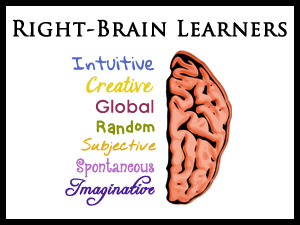
Right-brain learners like to be creative. They tend to think “outside of the box.” They are dreamers and risk-takers.
As I described in Left-Brain, Right-Brain, Whole-Brain Learning, all learners use both sides of the brain to learn, however many people have a dominant hemisphere that they tend to use more often in learning situations. When you are aware of your child’s dominant hemisphere (if he has one) you will find that you will have an easier time teaching him in ways that work.
Today, I’m going to describe for you the unique characteristics of right-brain learners. In addition, I’ll give you some tips that will help you teach a right-brain learner effectively. It is my desire that sharing this knowledge with you will provide you with handy techniques for teaching your child.
*This post contains paid links. I earn a small commission from the sale of products purchased via these links. Please see my disclosure for details.
Characteristics of Right-Brain Learners
Below you’ll find some traits of right-brain learners. Bear in mind that not all of these characteristics will be true for all right-brain learners. If you find that most of them are true for your child, he may be a right-brain learner.
Right-brain learners:
- are global
- use their intuition
- are inclined to be spontaneous
- like to be creative
- remember faces
- are risk-takers
- look for similarities in things
- are emotional
- tend to look at the big picture before the details
- go from one task to another in a random way
- prefer hands-on
- favor open-ended assignments to structured ones
- would rather answer open-ended, short-answer, and essay questions
- remember information that they have become emotionally involved with
- like to use their imagination
- are dreamers
- see possibilities
- are subjective
- tend to be spatially oriented
- may be artistic (visual or performing arts)
- find it a challenge to meet deadlines
- may be late to appointments
- tend to be kinesthetic learners
- think “out-of-the-box”
- prefer demonstrations and examples
- like to see how things are connected
- express their feelings
- solve problems with hunches
- may like to listen to music while working
- use inductive reasoning
- like positive reinforcement
- want to be accepted
- value relationships
- like to draw and learn through pictures
- favor a flexible, unstructured environment
- prefer emotional and inspirational presentations
- like to work in groups
- make decisions based on experiences and intuition
- remember images best
- may use hand gestures when speaking
- are good at multitasking
- want to know the “why” before doing something
Tips for Helping Right-Brain Learners
Here are some techniques you can utilize when teaching a right-brain learner. They can be used to modify curriculum you already have or you can apply these methods when developing your own curriculum.
- Use a whole-to-parts approach when teaching your child
- Since right-brain learners remember pictures best, use lots of visuals
- Have a flexible learning environment
- Let your child brainstorm
- Have music playing in the background while your child studies
- Assign projects
- Tie learning to feelings (how do you think that person felt, how do you feel about…)
- Let your child role-play
- Provide hands-on activities
- Use charts, mind maps, and other graphic organizers to help your child see the “big picture”
- Let your child work in small groups
- Use colors and pictures on flashcards
- Use humor when teaching
- Let your child draw pictures to help him learn and remember concepts
- When giving your child verbal instructions, draw images on a whiteboard or chalkboard to help him remember
- Provide a creative outlet for your child with activities like creative writing, art, music, and Reader’s Theater
- Show your child the “big picture” or the main concept before describing the parts
- Let your child use hand gestures and other motions to describe concepts and solidify learning
- Demonstrate skills or processes that you want your child to learn so that he can imitate you
- Have open-ended discussions with your child
- Let your child see you do a task from beginning to end before having him attempt it
- Have your child make a collage about a particular topic
- Discuss with your child the best ways to appropriately express his emotions
- Have your child do experiments
- Give your child open-ended questions including essay and short-answer questions
- Let your child solve picture puzzles or puzzles that use inductive reasoning like riddles and 5-minute mysteries.


I hope you find these tips helpful for teaching your child.
If you would like to learn about the other dominant side of the brain, click on the link below.
Many blessings,