
Memorizing addition facts can be challenging for your child.
You can make this job easier by showing him some of the simple patterns found in these facts.
Not sure what some of those patterns are?
That’s okay. I’ve got you covered. 😉
I have descriptions of the patterns below as well as tips for teaching them.
I hope they make memorization of addition facts much easier for your child. 🙂
Patterns in Addition Facts
Plus Zero and Plus One
These are the two easiest patterns to learn. I always used to tell kids that adding zero is adding nothing, so the number it’s added to stays the same. Adding one is the same as counting up to the next number. Super easy, right? Now what about those bigger numbers?
Plus Two
Adding two is the same as going to the next odd or even number. Let me show you what I mean. Let’s say we have this problem:
4 + 2 =
4 is an even number, right? Adding 2 to it means you jump to the next even number, 6. This works for odd numbers too.
5 + 2 =
5 is odd and adding 2 to it means you jump to the next odd number which is 7.
I highly recommend that you have your child practice counting aloud from 0 – 20 by even numbers and from 1 – 21 by odd numbers on a daily basis starting in 1st grade. Do it until they have mastered it. You can start by having the numbers written out for him (the visual cue), and then later take it away to check memorization. It only takes a minute to do and you can start out each of your daily math lessons with this exercise. Mastery of odds and evens is important for later math concepts.
Doubles and Doubles Plus One
Let’s look at the pattern for Doubles and Doubles Plus One in addition.
Here are the Doubles.
1 + 1 = 2
2 + 2 = 4
3 + 3 = 6
4 + 4 = 8
5 + 5 = 10
6 + 6 = 12
7 + 7 = 14
8 + 8 = 16
9 + 9 = 18
Notice that all of the answer are even. I would point that out to your child. I would also encourage her to memorize the Doubles and then progress to the Doubles Plus One.
Here is what the Doubles Plus One facts look like.
1 + 2 = 3
2 + 3 = 5
3 + 4 = 7
4 + 5 = 9
5 + 6 = 11
6 + 7 = 13
7 + 8 = 15
8 + 9 = 17
The answers are all odds! They are, of course, one more than the answers for the doubles. I would point out these details to your child before he starts to memorize them. This will make it easier for him in the long run.
Magic Nines
Nines are magical because they are so close to ten. Here is a story you can tell your child about nines.
“Nines are magicians. They always want to be a ten so they have a trick that they do. They lay down their magic wands (write a 1 for the tens place for your child) and zap one away from their partner number (write down the number one less than the number they are added to). So for 9 + 3, the magic 9 lays down his wand (write the 1 in the tens place) and zaps one away from the 3 (write a 2 next to the 1). Ta – dah! You have the answer, 12!”
I would use a list of the nines math facts to help demonstrate this story and to help your child see the pattern of nines.
Tens
Memorizing the numbers that add up to ten is really helpful for kids. It can be used when they start using mental math for adding bigger numbers like 33 + 7 = 40. Let’s look at the pattern for tens.
5 + 5 = 10
4 + 6 = 10
6 + 4 = 10
3 + 7 = 10
7 + 3 = 10
2 + 8 = 10
8 + 2 = 10
1 + 9 = 10
9 + 1 = 10
You can see that if your child already knows the Ones (easy), Plus Twos, and Doubles, that leaves only 2 pairs of numbers to remember: 4 and 6, and 3 and 7. That’s a little more manageable. He should have no problem learning those in a short time.
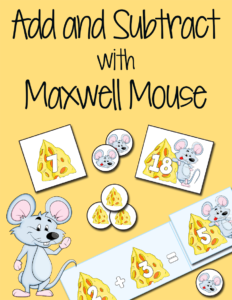
If you want to give your child an opportunity to practice math facts using ten frames, counters, addition and subtraction practice mats, practice cards, and other manipulatives, you may want to take a peek at Add and Subtract with Maxwell Mouse. It’s a mouse-themed math pack that uses a hands-on approach to learning addition and subtraction facts that can be used to you show your child patterns in addition.
I hope these tips helped your child learn addition facts. 🙂
Many blessings,